Write triggers in a ROOT format. More...
#include <Triggers.h>
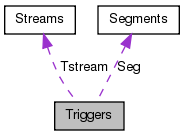
Public Member Functions | |
| bool | AddSegment (const double gps_start, const double gps_end, const int tag=-1) |
| Adds a segment to the Triggers object. | |
| bool | AddSegments (Segments *aSeg) |
| Adds segments to the Triggers object. | |
| bool | AddTrigger (const double atime, const double afrequency, const double asnr, const double aq, const double atstart, const double atend, const double afstart, const double afend, const double aamp) |
| Adds a trigger to the Triggers object. | |
| bool | GetMaxFlag (void) |
| Returns the max limit flag value. | |
| bool | GetNtrig (void) |
| Returns the current number of triggers in memory. | |
| bool | GetNTrig (void) |
| Returns the current number of triggers in memory. | |
| Segments * | GetTriggerSegments (TH1D *aThr, const double aPadding=0.0, const double aInfValue=1e20) |
| Returns a set of segments built with triggers above a given threshold. | |
| bool | InitUserMetaData (vector< string > aMusername, vector< string > aMusertype) |
| Initializes the user-defined meta-data fields. | |
| bool | Reset (void) |
| Resets the Triggers objects. | |
| bool | SetClusterDeltaT (const double DeltaT) |
| Sets the clustering delta_t parameter. | |
| bool | SetClustering (const string Algo="TIME") |
| Activates the clustering. | |
| void | SetMdetindex (const int aMdetindex) |
| Set the detector index value for the meta-data field 'Mdetindex'. | |
| void | SetMprocessname (const string aMprocessname) |
| Set the process name for the meta-data field 'Mprocessname'. | |
| void | SetMstreamname (const string aMstreamname) |
| Set the stream name for the meta-data field 'Mstreamname'. | |
| void | SetNtriggerMax (const int aNmax) |
| Sets the maximum number of triggers per file (NtriggerMax). | |
| bool | SetOutputDirectory (const string aoutdir) |
| Sets a new output directory to save trigger files. | |
| bool | SetSegments (Segments *aSeg) |
| Sets segments to the Triggers object. | |
| bool | SetUserMetaData (const string aMusername, const string aMuservalue) |
| Set user-defined meta-data. | |
| bool | SetUserMetaData (const string aMusername, const int aMuservalue) |
| Set user-defined meta-data. | |
| bool | SetUserMetaData (const string aMusername, const double aMuservalue) |
| Set user-defined meta-data. | |
| void | SetVerbose (const int averbose) |
| Sets verbosity level. | |
| string | Write (const string mode="PROC", const string filename="default", const bool sorttriggers=true, const bool writemetadata=true) |
| Writes triggers on disk. | |
Constructors and destructors | |
| Triggers (const string aoutdir, const string aoutfile, const string afileformat="root", const int averbose=0) | |
| Constructor of the Triggers class. | |
| virtual | ~Triggers (void) |
| Destructor of the Triggers class. | |
Protected Attributes | |
| double | Camp |
| cluster amplitude | |
| double | Cdelta_t |
| clustering time window in ms | |
| double | Cfend |
| cluster frequency end | |
| double | Cfreq |
| cluster frequency | |
| double | Cfstart |
| cluster frequency start | |
| bool | cluster_OK |
| clustering flag | |
| double | Cq |
| cluster Q | |
| double | Csnr |
| cluster SNR | |
| double | Ctend |
| cluster time end | |
| double | Ctime |
| cluster time | |
| TTree * | Ctree |
| clusters tree | |
| double | Ctstart |
| cluster time start | |
| string | fAlgo |
| clustering algorithm | |
| vector< string > | ffileformat |
| output file formats | |
| string | foutdir |
| output directory | |
| string | foutfile |
| output file base name | |
| int | fverbose |
| verbosity level | |
| bool | Maxflag |
| maximum number of triggers flag | |
| int | Mdetindex |
| meta detector index | |
| double * | Mdvar |
| user metatree var - double | |
| double | Mend |
| meta end time | |
| double | Mfmax |
| meta maximum frequency | |
| double | Mfmin |
| meta minimum frequency | |
| int * | Mivar |
| user metatree var - int | |
| string | Mprocessname |
| meta process name | |
| double | Mqmax |
| meta maximum Q | |
| double | Mqmin |
| meta minimum Q | |
| double | Msnrmax |
| meta maximum SNR | |
| double | Msnrmin |
| meta minimum SNR | |
| double | Mstart |
| meta start time | |
| string | Mstreamname |
| meta stream name | |
| string * | Msvar |
| user metatree var - string | |
| TTree * | Mtree |
| metadata tree | |
| vector< string > | Musername |
| user metadata name | |
| vector< string > | Musertype |
| user metadata type | |
| int | NtriggerMax |
| maximum number of triggers per file | |
| Segments * | Seg |
| segment structure | |
| bool | status_OK |
| class status | |
| double | Tamp |
| trigger amplitude | |
| double | Tfend |
| trigger ending frequency | |
| double | Tfreq |
| trigger peak frequency | |
| double | Tfstart |
| trigger starting frequency | |
| double | Tq |
| trigger Q | |
| double | Tsnr |
| trigger SNR | |
| Streams * | Tstream |
| stream structure | |
| double | Ttend |
| trigger ending time | |
| double | Ttime |
| trigger peak time | |
| TTree * | Ttree |
| triggers tree | |
| double | Ttstart |
| trigger starting time | |
| int | Ttstart_ms |
| trigger starting time (ms) | |
Write triggers in a ROOT format.
This class was designed to write triggers in a ROOT tree following the GWOLLUM convention for triggers. When triggers are produced by some external algorithms, the Triggers class can be used to manage output triggers, to save them and to perform some basic operations (like clustering).
| Triggers::Triggers | ( | const string | aoutdir, | |
| const string | aoutfile, | |||
| const string | afileformat = "root", |
|||
| const int | averbose = 0 | |||
| ) |
Constructor of the Triggers class.
The trigger files are saved in the directory 'aoutdir'. The base name for the file name is 'aoutfile'. No file extension should be given in 'aoutfile'. The file name is completed by the timing of the triggers contained in the file. The output file format is determined by 'afileformat'. The verbosity level, set by 'averbose', follows the GWOLLUM convention for verbosity.
Supported file formats:
To save the triggers in several different formats, enter a string containing all the desired formats.
It should be noted that saving triggers in a format other than ROOT is a dead-end for GWOLLUM. Indeed, GWOLLUM is entirely based on ROOT, therefore, GWOLLUM routines can only read and process triggers if they are saved in a ROOT format. For this reason, the user is strongly encouraged to save triggers in a ROOT format.
| aoutdir | output directory | |
| aoutfile | base name for output trigger files | |
| afileformat | output file formats | |
| averbose | verbosity level |
| Triggers::~Triggers | ( | void | ) | [virtual] |
Destructor of the Triggers class.
| bool Triggers::AddSegment | ( | const double | gps_start, | |
| const double | gps_end, | |||
| const int | tag = -1 | |||
| ) |
Adds a segment to the Triggers object.
No check is performed with respect to the triggers added with AddTrigger(). The user must make sure that the segment is compatible with the triggers as described in the GWOLLUM convention for triggers. true is returned in case of success.
| gps_start | segment start | |
| gps_end | segment end | |
| tag | segment tag |
| bool Triggers::AddSegments | ( | Segments * | aSeg | ) |
Adds segments to the Triggers object.
No check is performed with respect to the triggers added with AddTrigger(). The user must make sure that the segments are compatible with the triggers as described in the GWOLLUM convention for triggers. true is returned in case of success.
| aSeg | Segments object to be added |
| bool Triggers::AddTrigger | ( | const double | atime, | |
| const double | afrequency, | |||
| const double | asnr, | |||
| const double | aq, | |||
| const double | atstart, | |||
| const double | atend, | |||
| const double | afstart, | |||
| const double | afend, | |||
| const double | aamp | |||
| ) |
Adds a trigger to the Triggers object.
The trigger parameters are defined in the GWOLLUM convention for triggers. The timing parameters (time, tstart and tend) are recorded with a precision of 1 microsecond.
The number of added triggers cannot exceed NtriggerMax fixed by the SetNtriggerMax() function, false is returned if this value is exceeeded.
| atime | ||
| afrequency | ||
| asnr | ||
| aq | ||
| atstart | = Min( atstart, atime ) | |
| atend | = Max( atend, atime ) | |
| afstart | = Min( afstart, afrequency ) | |
| afend | = Max( afend, afrequency ) | |
| aamp |
| bool Triggers::GetMaxFlag | ( | void | ) | [inline] |
| bool Triggers::GetNtrig | ( | void | ) | [inline] |
Returns the current number of triggers in memory.
| bool Triggers::GetNTrig | ( | void | ) | [inline] |
Returns the current number of triggers in memory.
| Segments * Triggers::GetTriggerSegments | ( | TH1D * | aThr, | |
| const double | aPadding = 0.0, |
|||
| const double | aInfValue = 1e20 | |||
| ) |
Returns a set of segments built with triggers above a given threshold.
The threshold object is an histogram binned in frequency and filled with SNR thresholds. Triggers are selected when applying the SNR threshold at the trigger frequency. For each selected trigger, a segment is defined from tstart to tend. A time pad can be added at both segment ends with 'aPadding'.
If, for some frequency bins, the SNR threshold exceeds 'aInfValue', the threshold is considered as infinite and no triggers can be selected for this frequency bin.
NB: The user is in charge of deleting the output Segments object.
NB: This function should be called while the triggers ar still memory. For example, it should be called before the Write() function is called.
If this function fails, an empty Segments is returned.
| aThr | SNR threshold binned in frequency | |
| aPadding | extra time padding to be added at both segment ends | |
| aInfValue | SNR value above which the threshold is considered as infinitely high. |
| bool Triggers::InitUserMetaData | ( | vector< string > | aMusername, | |
| vector< string > | aMusertype | |||
| ) |
Initializes the user-defined meta-data fields.
'aMusername' should be a non-empty vector with the list of meta-data names. 'aMuservalue' should be a vector with the list of meta-data types (same size as aMusername). Supported types: "d" for double, "i" for int, "s" for string. Default values are -1 for double and int types and "none" for string type.
| aMusername | vector of metadata names | |
| aMusertype | vector of metadata types (i/d/s) |
| bool Triggers::Reset | ( | void | ) |
| bool Triggers::SetClusterDeltaT | ( | const double | DeltaT | ) |
Sets the clustering delta_t parameter.
For the "TIME" clustering algorithm, this function sets a new value for the delta_t parameter. This value must be given in seconds and cannot be smaller than 0.001s. See SetClustering().
| DeltaT | new delta_t value |
| bool Triggers::SetClustering | ( | const string | Algo = "TIME" |
) |
Activates the clustering.
A clustering algorithm can be applied on produced triggers. This function initiates the clustering method. It should be called <u>once</u> before writing the first output file with the Write() function. If the ROOT format was chosen, the output tree containing the clusters will be named 'clusters'.
true is returned in case of success.
Several clustering algorithms are available and are set by the 'Algo' option.
   This method was specifically developed for Omicron triggers.
   Triggers are represented by tiles laying on time-frequency maps.
   A time-frequency map is defined by a Q value. With this clustering
   method when 2 tiles overlap in time or in frequency, only the tile
   with the highest SNR is kept.
   This clustering method can be highly destructive.
   A trigger is defined by a time value and a duration (tend - tstart).
   This clustering method can be described by the following logic:
                                                       'time'
   A trigger can be represented by a time segment:  |----||--------|
                                                 tstart           tend

   2 consecutive triggers are clustered if they verify one of the 2 following scenarios:

   Scenario#1: overlapping triggers,
        trigger#1 |---||---------|
        trigger#2            |--------||--|

   Scenario#2: if the distance inter-triggers dt < delta_t,
        trigger#1 |---||---------|
        trigger#2                      |--------||--|
                                 <----->
                                    dt

   In Scenario#2, 2 consecutive triggers are clustered if the time distance
   between them is smaller than the delta_t parameter. This parameter is equal
   to 100ms by default. It can be changed with the SetClusterDeltaT() function.
| Algo | clustering algorithm |
| void Triggers::SetMdetindex | ( | const int | aMdetindex | ) | [inline] |
Set the detector index value for the meta-data field 'Mdetindex'.
See GWOLLUM convention. By default Mdetindex = guessed from the file base name given in Triggers().
| aMdetindex | detector index |
| void Triggers::SetMprocessname | ( | const string | aMprocessname | ) | [inline] |
Set the process name for the meta-data field 'Mprocessname'.
See GWOLLUM convention. By default Mprocessname = "unknown".
| aMprocessname | process name |
| void Triggers::SetMstreamname | ( | const string | aMstreamname | ) | [inline] |
Set the stream name for the meta-data field 'Mstreamname'.
See GWOLLUM convention. By default Mstreamname = file base name given in Triggers().
| aMstreamname | stream name |
| void Triggers::SetNtriggerMax | ( | const int | aNmax | ) | [inline] |
Sets the maximum number of triggers per file (NtriggerMax).
No trigger can be added if this limit is reached. By default the number of triggers is limited to 1,000,000 per file.
| aNmax | new limit value |
| bool Triggers::SetOutputDirectory | ( | const string | aoutdir | ) | [inline] |
Sets a new output directory to save trigger files.
The new directory must exist.
| aoutdir | new output directory |
| bool Triggers::SetSegments | ( | Segments * | aSeg | ) |
Sets segments to the Triggers object.
When this function is used any previous Segments object is deleted and replaced by this new set of segments.
No check is performed with respect to the triggers added with AddTrigger(). The user must make sure that the segments are compatible with the triggers as described in the GWOLLUM convention for triggers. true is returned in case of success.
| aSeg | Segments object to be used |
| bool Triggers::SetUserMetaData | ( | const string | aMusername, | |
| const string | aMuservalue | |||
| ) |
Set user-defined meta-data.
Set the meta-data named 'aMusername' with the value 'aMuservalue'.
| aMusername | metadata name | |
| aMuservalue | metadata value |
| bool Triggers::SetUserMetaData | ( | const string | aMusername, | |
| const int | aMuservalue | |||
| ) |
Set user-defined meta-data.
Set the meta-data named 'aMusername' with the value 'aMuservalue'.
| aMusername | metadata name | |
| aMuservalue | metadata value |
| bool Triggers::SetUserMetaData | ( | const string | aMusername, | |
| const double | aMuservalue | |||
| ) |
Set user-defined meta-data.
Set the meta-data named 'aMusername' with the value 'aMuservalue'.
| aMusername | metadata name | |
| aMuservalue | metadata value |
| void Triggers::SetVerbose | ( | const int | averbose | ) | [inline] |
Sets verbosity level.
| averbose | new verbosity level |
| string Triggers::Write | ( | const string | mode = "PROC", |
|
| const string | filename = "default", |
|||
| const bool | sorttriggers = true, |
|||
| const bool | writemetadata = true | |||
| ) |
Writes triggers on disk.
This function writes all the triggers added until now in the output file as well as the segment and metadata trees. The Triggers object is then completely resetted and the user can add more triggers with the AddTrigger() function and call the Write() function again and so on... The user should be careful and call this function often enough not to reach the maximum number of triggers per file (1,000,000 by default).
The output file path is returned. "none" is returned if this function fails in some way.
If the clustering has been activated, clustering is then performed here, just before writing the output file.
The optional argument 'mode' is only taken into account if the clustering mode was activated. In that case, the user can choose between 2 writing modes:
The optional argument 'filename' allows to bypass the file naming GWOLLUM convention. With this option, the triggers will be saved in: [aoutdir]/[filename].[afileformat], where 'aoutdir' and 'afileformat' are given in the constructor.
If the optional flag 'sorttriggers' is set to true, the collected triggers are first sorted by starting times before being saved on disk. This flag can be set to false if the user knows that the triggers were already added with the correct time order.
| mode | writing mode: "PROC" or "ALL" | |
| filename | new base name for ouput file | |
| sorttriggers | flag to sort triggers before saving | |
| writemetadata | flag to save metadata tree |
double Triggers::Camp [protected] |
cluster amplitude
double Triggers::Cdelta_t [protected] |
clustering time window in ms
double Triggers::Cfend [protected] |
cluster frequency end
double Triggers::Cfreq [protected] |
cluster frequency
double Triggers::Cfstart [protected] |
cluster frequency start
bool Triggers::cluster_OK [protected] |
clustering flag
double Triggers::Cq [protected] |
cluster Q
double Triggers::Csnr [protected] |
cluster SNR
double Triggers::Ctend [protected] |
cluster time end
double Triggers::Ctime [protected] |
cluster time
TTree* Triggers::Ctree [protected] |
clusters tree
double Triggers::Ctstart [protected] |
cluster time start
string Triggers::fAlgo [protected] |
clustering algorithm
vector<string> Triggers::ffileformat [protected] |
output file formats
string Triggers::foutdir [protected] |
output directory
string Triggers::foutfile [protected] |
output file base name
int Triggers::fverbose [protected] |
verbosity level
bool Triggers::Maxflag [protected] |
maximum number of triggers flag
int Triggers::Mdetindex [protected] |
meta detector index
double* Triggers::Mdvar [protected] |
user metatree var - double
double Triggers::Mend [protected] |
meta end time
double Triggers::Mfmax [protected] |
meta maximum frequency
double Triggers::Mfmin [protected] |
meta minimum frequency
int* Triggers::Mivar [protected] |
user metatree var - int
string Triggers::Mprocessname [protected] |
meta process name
double Triggers::Mqmax [protected] |
meta maximum Q
double Triggers::Mqmin [protected] |
meta minimum Q
double Triggers::Msnrmax [protected] |
meta maximum SNR
double Triggers::Msnrmin [protected] |
meta minimum SNR
double Triggers::Mstart [protected] |
meta start time
string Triggers::Mstreamname [protected] |
meta stream name
string* Triggers::Msvar [protected] |
user metatree var - string
TTree* Triggers::Mtree [protected] |
metadata tree
vector<string> Triggers::Musername [protected] |
user metadata name
vector<string> Triggers::Musertype [protected] |
user metadata type
int Triggers::NtriggerMax [protected] |
maximum number of triggers per file
Segments* Triggers::Seg [protected] |
segment structure
bool Triggers::status_OK [protected] |
class status
double Triggers::Tamp [protected] |
trigger amplitude
double Triggers::Tfend [protected] |
trigger ending frequency
double Triggers::Tfreq [protected] |
trigger peak frequency
double Triggers::Tfstart [protected] |
trigger starting frequency
double Triggers::Tq [protected] |
trigger Q
double Triggers::Tsnr [protected] |
trigger SNR
Streams* Triggers::Tstream [protected] |
stream structure
double Triggers::Ttend [protected] |
trigger ending time
double Triggers::Ttime [protected] |
trigger peak time
TTree* Triggers::Ttree [protected] |
triggers tree
double Triggers::Ttstart [protected] |
trigger starting time
int Triggers::Ttstart_ms [protected] |
trigger starting time (ms)
 1.6.1
1.6.1

