Read a segment list sequentially (for Omicron). More...
#include <Odata.h>
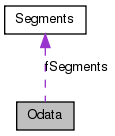
Public Member Functions | |
| int | GetChunkTimeEnd (void) |
| Returns the GPS ending time of current chunk. | |
| int | GetChunkTimeStart (void) |
| Returns the GPS starting time of current chunk. | |
| int | GetNSegments (void) |
| Returns number of subsegments per chunk. | |
| int | GetSegmentTimeEnd (const int aNseg) |
| Returns the GPS ending time of segment aNseg. | |
| int | GetSegmentTimeStart (const int aNseg) |
| Returns the GPS starting time of segment aNseg. | |
| bool | GetStatus (void) |
| Returns current class status. | |
| bool | NewChunk (void) |
| Loads a new (next) chunk. | |
| bool | SetSegments (Segments *aSegments) |
| Sets the segments to read. | |
Constructors and destructors | |
| Odata (const int aChunkDuration, const int aSegmentDuration, const int aOverlapDuration, const int aVerbosity=0) | |
| Constructor of the Odata class. | |
| virtual | ~Odata (void) |
| Destructor of the Odata class. | |
Read a segment list sequentially (for Omicron).
A Segments object is segmented with several levels to perform an organized analysis of data segments. The input segments are divided into overlapping chunks. The chunks can be represented in the following way:
 |------------------| chunk i-1
                |------------------| chunk i
                               |------------------| chunk i+1

                |---| overlap
Chunks are subdivided in subsegments overlaping the same way as chunks:
 |------------------------------------------| chunk i
 |----------| subsegment 0
         |----------| subsegment 1
                 |----------| subsegment 2
                         |----------| subsegment 3
                                 |----------| subsegment 4

                                         |------------------------------------------| chunk i+1
The chunk duration is pre-defined. However, if the input segment is not long enough, the chunk size is adjusted to fit the maximum number of subsegments. The segment size cannot be ajusted.
| Odata::Odata | ( | const int | aChunkDuration, | |
| const int | aSegmentDuration, | |||
| const int | aOverlapDuration, | |||
| const int | aVerbosity = 0 | |||
| ) |
Constructor of the Odata class.
| aChunkDuration | chunk duration [s] | |
| aSegmentDuration | subsegment duration [s] | |
| aOverlapDuration | overlap duration [s] | |
| averbose | verbosity level |
| Odata::~Odata | ( | void | ) | [virtual] |
Destructor of the Odata class.
| int Odata::GetChunkTimeEnd | ( | void | ) | [inline] |
Returns the GPS ending time of current chunk.
| int Odata::GetChunkTimeStart | ( | void | ) | [inline] |
Returns the GPS starting time of current chunk.
| int Odata::GetNSegments | ( | void | ) | [inline] |
Returns number of subsegments per chunk.
| int Odata::GetSegmentTimeEnd | ( | const int | aNseg | ) |
Returns the GPS ending time of segment aNseg.
Returns -1 if this function fails.
| aNseg | segment number |
| int Odata::GetSegmentTimeStart | ( | const int | aNseg | ) |
Returns the GPS starting time of segment aNseg.
Returns -1 if this function fails.
| aNseg | segment number |
| bool Odata::GetStatus | ( | void | ) | [inline] |
Returns current class status.
| bool Odata::NewChunk | ( | void | ) |
Loads a new (next) chunk.
The chunks are loaded following the structure defined for the Odata class and the Segments object defined with SetSegments(). When there is not enough data to fill one chunk (end of a segment), the chunk duration is shortened. This function should be called iteratively to cover the full data set. The returned value indicates the status of this operation:
| bool Odata::SetSegments | ( | Segments * | aSegments | ) |
 1.6.1
1.6.1

